
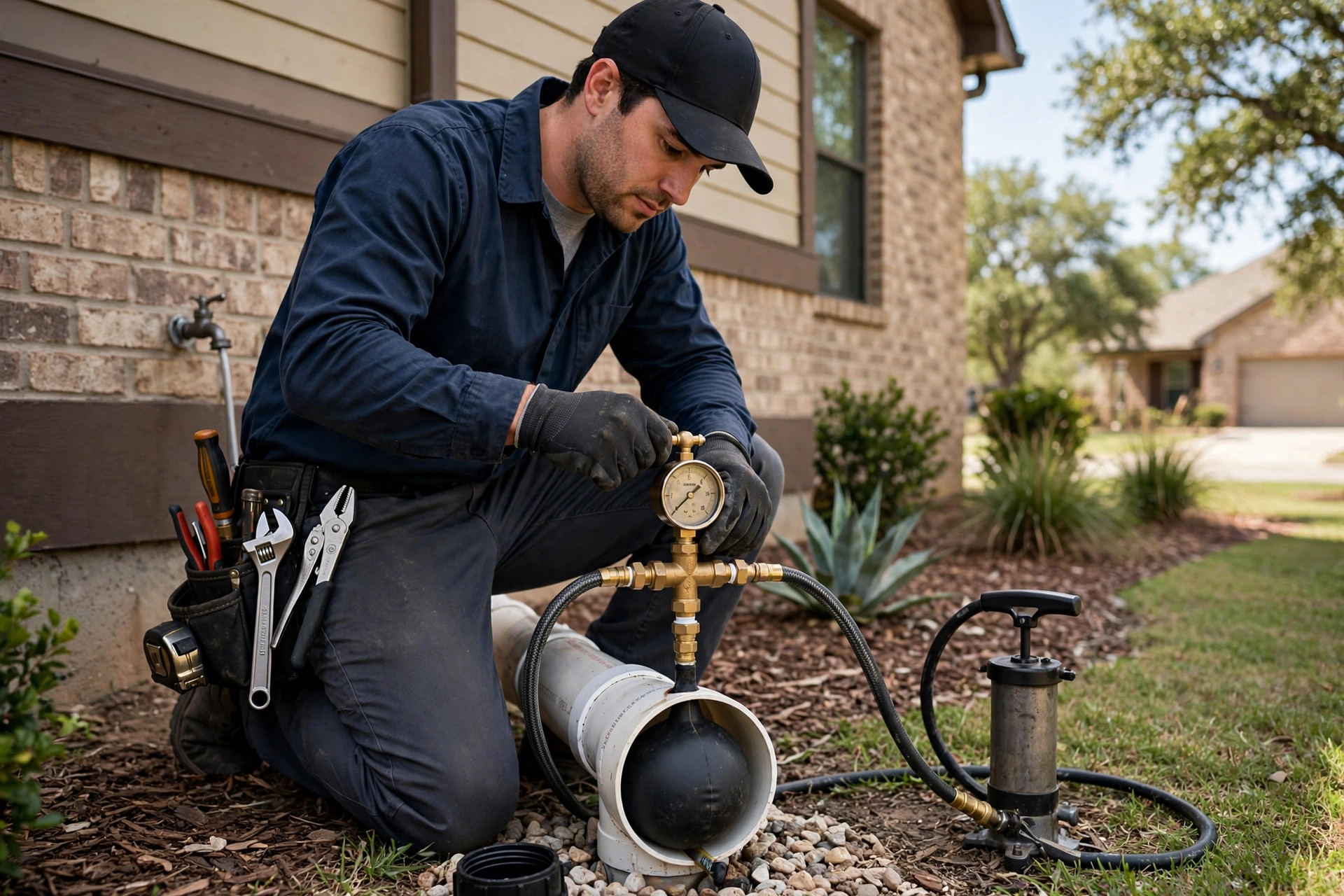
What is hydrostatic testing? In Little Elm, TX, hydrostatic testing is a pressure-based method used to assess whether a plumbing section can maintain pressure under controlled conditions. In slab leak investigations, it can help establish whether a tested section is leaking.
What it helps answer
- Is pressure being maintained?
- Is the tested section likely leaking?
- Is more diagnostic work needed?
What it does not prove alone
A pressure result does not always identify the exact pipe defect or explain the cause. It is strongest when combined with symptoms, line layout and other findings.
What the test does
Hydrostatic testing checks the drain, waste and vent lines under a slab for leaks. The line is plugged and filled with water, usually up to a cleanout or a set height, and the water level is watched over time. If the level holds, the line is holding. If it drops, water is escaping somewhere along the run.
This is different from the pressure testing used on supply lines. Supply lines carry pressurized water, while drain lines carry wastewater by gravity, so they need a different test. Hydrostatic testing answers one specific question: does the under-slab drain system hold water?
How it is performed
A technician locates an access point, often a drain cleanout, and inserts an inflatable test ball or plug to seal the line. The system is then filled with water to a marked level. The level is monitored for a set period, and any drop is measured.
The setup is contained: the water goes into the drain system, not onto floors. Access is usually through existing cleanouts, so the process does not require opening the slab. Multiple sections can be tested separately to narrow down which part of the system is losing water.
What a failing test tells you
A dropping water level means the drain system has a breach: a cracked pipe, a separated joint, or a failed fitting under the slab. The rate of the drop gives a rough sense of the size of the problem, though it does not show the exact location by itself.
A failed test is a strong finding, but it is the start of the locating phase rather than the end of the diagnosis. Follow-up methods narrow down where along the run the water is escaping, which is what the repair plan needs.
What it cannot tell you by itself
Hydrostatic testing does not test the pressurized supply lines, so a passing test does not rule out a supply-side slab leak. It also does not pinpoint the exact location of a drain leak; it confirms that a leak exists in the tested section.
Groundwater, a high water table or water already in the line can complicate the reading, which is why the test is run and interpreted by someone experienced. Like every diagnostic, it is one piece of evidence, and the full picture comes from combining it with the symptoms and other findings during detection.
When hydrostatic testing is usually recommended in Little Elm, TX
Hydrostatic testing is commonly suggested when the symptoms point at the drain side: recurring sewer odors, slow drains across multiple fixtures, damp spots with no supply-line explanation, or foundation movement that may have stressed the drain pipes. It is also used during real estate transactions when a buyer wants the under-slab drain system checked.
If the investigation instead points at a pressurized supply line, pressure testing and acoustic methods take priority. The symptoms decide which test runs first, and a good investigation matches the test to the clues rather than running everything at once. Repair planning follows once the failing section is identified.
Frequently asked questions
Does hydrostatic testing work on water supply lines?
No. It tests drain, waste and vent lines, which carry water by gravity. Pressurized supply lines are tested with pressure gauges instead. The symptoms decide which test is appropriate. Supply lines are checked with pressure gauges instead, and the symptoms decide which test runs first.
Is the test messy or disruptive?
Generally no. The water goes into the drain system through a cleanout, not onto floors. There is some setup around the access point, but the home stays clean and the test is non-destructive. The technician needs access to a cleanout, so clearing that area beforehand helps the visit go smoothly.
How long does a hydrostatic test take?
Setup plus monitoring usually takes a few hours. The water level needs enough observation time for a slow leak to show, so rushing the monitoring period can miss a small breach. The monitoring period should not be rushed, since a slow leak needs time to show up in the water level.
Can a failed test mean something other than a slab leak?
The failure means the drain system is losing water somewhere in the tested section. The breach could be under the slab or in another buried section, which is why locating work follows a failed test. Follow-up locating work narrows down where along the tested section the water is escaping.
Should I get one before buying a home?
Many buyers do, especially for homes with mature trees near sewer lines or with drain symptoms. It is a non-invasive way to check the under-slab drain system before committing to the purchase. Ask for the results in writing, since a documented test becomes part of the property record.
Need help after reading?
Use the phone line to discuss the symptoms at your property and the next diagnostic step.
☎ Call +1 972-945-2624