
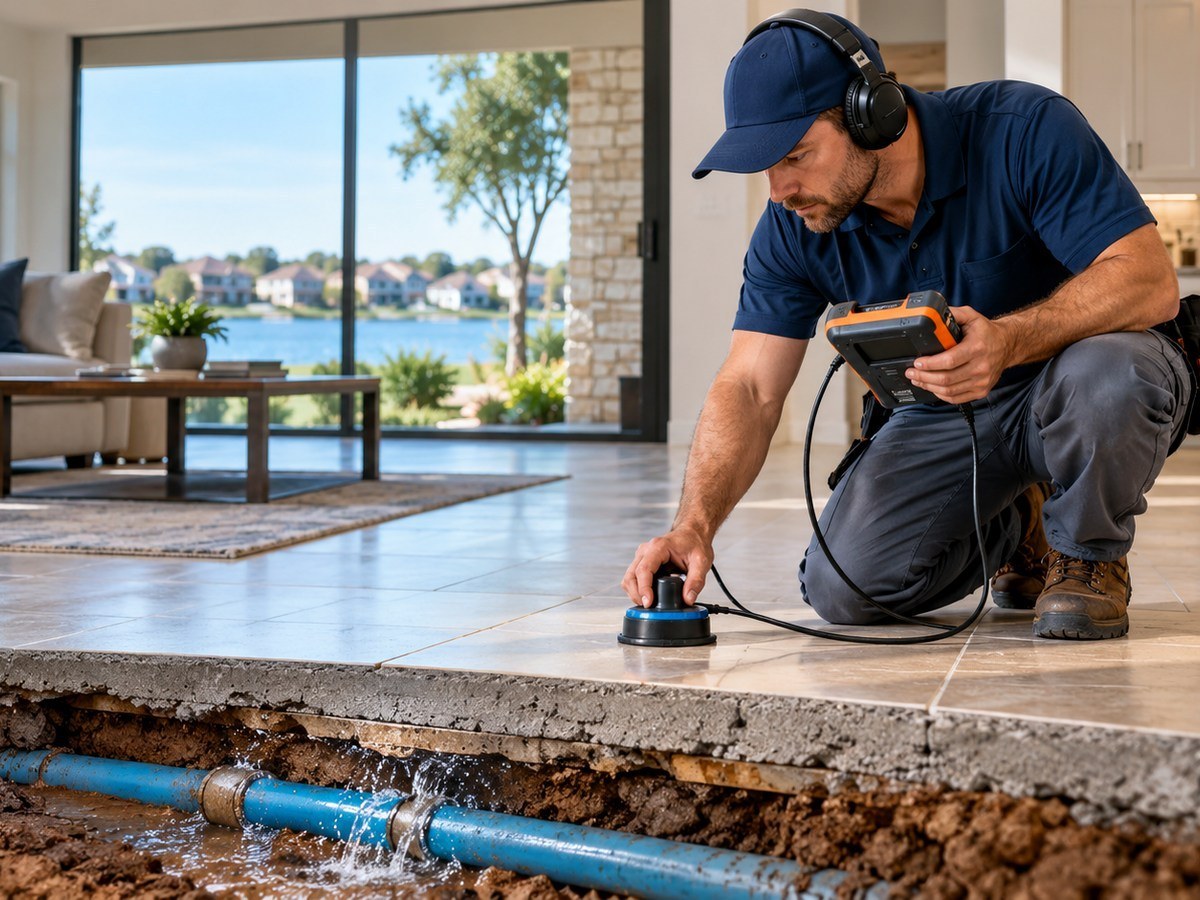
Electronic leak detection is a locating method, not a repair method. It answers a specific question that comes up in many slab leak investigations: exactly where does this buried pipe run? When a water line disappears under a slab, under soil, or beneath a driveway, guessing its route leads to extra digging and extra damage. Electronic detection puts a signal on the pipe and follows it above ground, which turns an unknown route into a marked path before anyone opens concrete or soil. It is commonly used as a planning step inside a broader slab leak detection process, alongside pressure isolation, acoustic listening, or hydrostatic pressure testing of drain lines. For general household background, EPA WaterSense publishes water-efficiency resources for homeowners.
What electronic detection is
Electronic detection, usually called electronic line tracing, is the practice of sending a traceable signal along a buried pipe and picking that signal up from the surface with a receiver. The pipe itself carries the signal along its length, and the operator sweeps the ground with a handheld receiver that gets louder or stronger as the wand passes directly over the line. Where the signal peaks, the pipe is below, and the path can be marked with paint or flags.
The method is most valuable for non-metallic piping. Materials like PEX, CPVC, PVC, and polyethylene do not respond to a standard metal detector, so a technician cannot simply sweep the yard with a metal-detecting wand and expect to find them. Copper and iron lines can sometimes be found with magnetic or inductive locators, but plastic lines are effectively invisible to those tools. Electronic tracing solves that by making the pipe itself the signal source, so the pipe material matters far less than the access used to put the signal on it.
It is important to understand what electronic detection does not do. It locates the route of the pipe. It does not, by itself, pinpoint the leak. A traced line tells you where to focus acoustic listening, where to isolate sections, or where to plan a repair opening. The leak position still has to be established by other tests. Treating line tracing as a leak pinpointing tool on its own is one of the most common misunderstandings about the method.
How the transmitter and receiver work
The system has two main parts: a transmitter and a receiver. The transmitter generates an electronic signal at a chosen frequency and applies it to the pipe. This is done at an access point, such as a hose bib, a shutoff valve, a water meter, a cleanout, or an exposed section of pipe. A direct connection to the pipe gives the cleanest signal, and an alligator clip or lead from the transmitter is typically attached there while a grounding stake completes the circuit.
Where a direct connection is not possible, the signal can sometimes be induced. Induction means placing the transmitter on the ground over the suspected pipe area so the signal radiates down and couples to the pipe inductively. This is less precise than a direct connection because nearby conductors, such as electrical conduit, rebar, or other buried utilities, can pick up the same induced signal. Direct connection is preferred whenever an access point is available.
The receiver is a handheld unit with an antenna that listens for the transmitter frequency. The operator holds it upright and walks a grid or a sweep pattern over the search area, watching a signal strength meter and listening to the tone. The strongest response marks the pipe centerline. Most receivers also give a rough depth estimate based on signal geometry, which helps when planning an excavation, although those depth readings are approximate rather than exact.
Frequency choice matters. Lower frequencies tend to travel farther along the pipe before fading, which is useful for long runs, while higher frequencies couple more readily to adjacent lines and can cause confusion in congested utility areas. An experienced operator selects the frequency based on the pipe material, the length of the run, and how many other buried services are nearby. This is one reason the method benefits from an operator who understands both the equipment and the site.
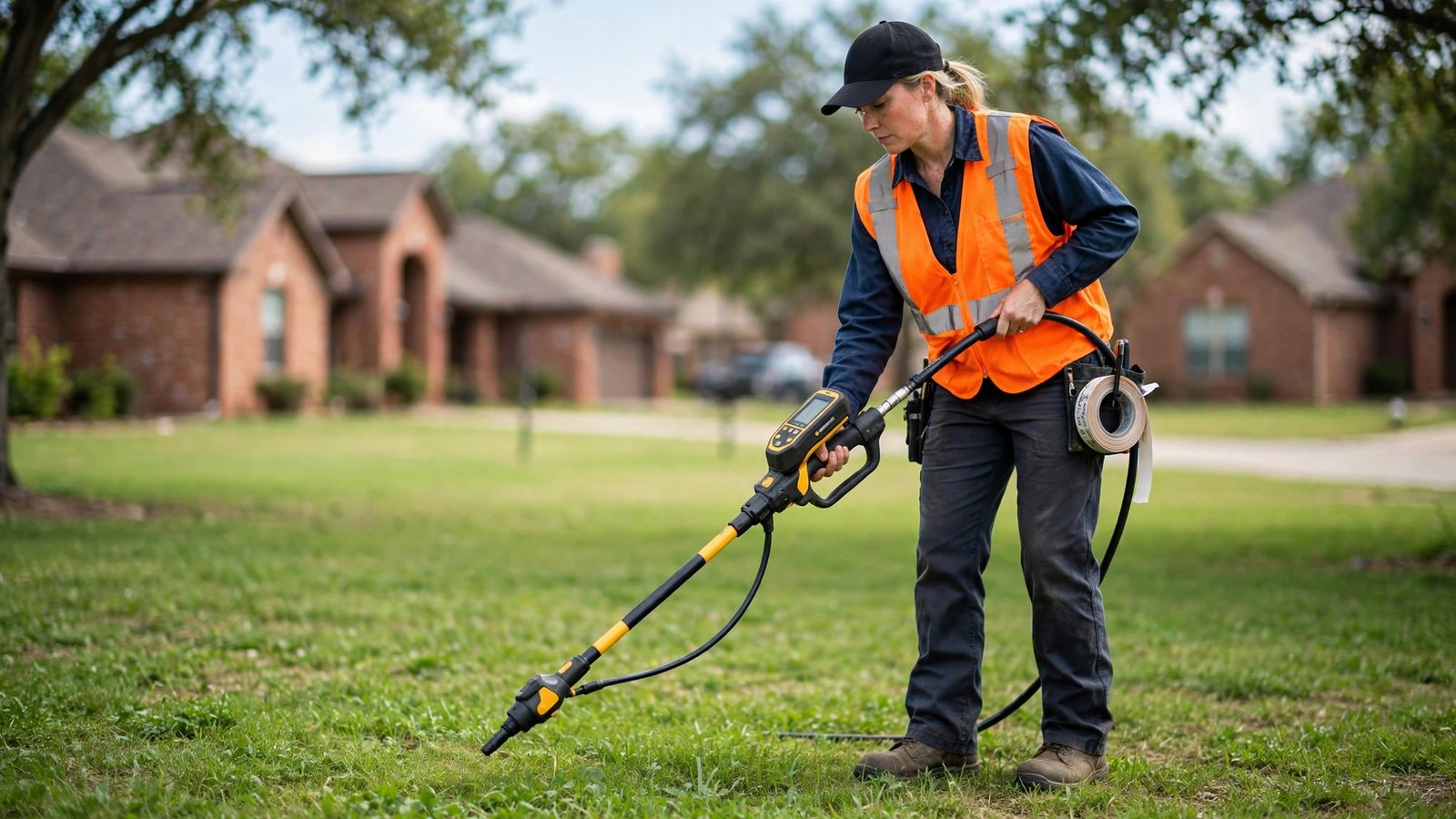
When line tracing is used
Line tracing is used whenever the pipe route is unknown and that unknown route affects the next decision. A common scenario is a suspected slab leak where the water line enters the slab at an unknown point. Before choosing between interior slab access, exterior tunneling, or rerouting, it helps to know where the line actually runs. Tracing it first can keep repair openings smaller and better placed.
It is also used for non-metallic service lines running from the meter to the house. Many Little Elm homes have plastic or PEX service laterals, and when one develops a leak, the first problem is finding the lateral at all. Tracing from the meter or from a hose bib can map the lateral across the yard without exploratory digging.
Planning is another major use. Before a reroute is designed, before a driveway is replaced, or before an addition is built, knowing where buried water lines run prevents accidental damage. Contractors and homeowners use tracing to confirm that planned work will not hit a live line. It is also used to verify or correct as-built drawings, which are frequently incomplete or inaccurate for older homes.
Finally, tracing is used when multiple fixtures or zones are fed from unclear branch lines. In a larger home or one with past remodels, the branch layout under the slab may not match the visible plumbing. Tracing individual branches from fixture shutoffs or manifold points can map which areas of the slab each line serves, which narrows the search when a leak signature, such as a warm floor spot, points to a general zone.
What problems it helps solve
The practical value of electronic detection is measured in avoided work. Every foot of misplaced excavation under a slab or in a yard costs time and restoration money. By marking the true pipe path, tracing concentrates the investigation on the right area. When combined with isolation testing, where sections of the system are shut off one at a time, the traced route turns a vague suspicion into a defined target.
It also reduces interior damage during planning. If a leak might be repaired by opening the slab, knowing the line location lets the opening be placed over the pipe instead of beside it. If tunneling from outside is under consideration, tracing shows where the line crosses the foundation so the tunnel can be planned to meet it. And if rerouting is the chosen path, the traced layout shows where the old line runs so the new route can be designed to avoid it and to reach the needed fixtures efficiently.
For homeowners dealing with high water bills and no visible leak, tracing can be part of the diagnostic chain. Once the service lateral is mapped, pressure testing or meter-based checks can determine whether that lateral is the losing line, and the mapped route tells the repair planner exactly where excavation would be needed.
The typical process
A line tracing visit usually follows a consistent sequence. First, there is a short site walkthrough to understand the problem, review any available plumbing drawings or past repair history, and identify likely access points such as the meter, hose bibs, cleanouts, and manifold locations. The operator also notes other buried utilities, irrigation lines, and electrical service paths that could carry stray signal.
Next, the transmitter is connected at the best available access point, and the receiver is checked against the known point to confirm the signal is clean. The operator then sweeps the expected area in a pattern, marking the strongest signal line as the pipe centerline. The sweep is often repeated from a second access point or in the opposite direction to confirm the route, since a confirmed mark from two directions is far more reliable than a single pass.
Depths are noted where the receiver provides them, and the marked route is documented, often with measurements referenced to fixed features like the house corner or the driveway edge. This documentation matters because the marks may need to survive days or weeks until the repair is scheduled, and painted marks can fade. A simple sketch with dimensions preserves the information.
Finally, the traced route is handed to whoever plans the next step, whether that is acoustic pinpointing, pressure testing, excavation, or reroute design. Line tracing is rarely the final step; it is the map that makes the final steps efficient.
Limitations to know about
Electronic detection has real limits, and an honest assessment should include them. The first is access. Without an access point where the transmitter can be attached to the pipe, the signal must be induced, and induction is less precise. In some properties, especially where the meter is far from the suspected area or lines are fully concealed, getting a clean direct connection can be difficult.
Signal interference is the second limit. Buried electrical lines, cable and telephone lines, irrigation wiring, rebar in the slab, and even metal fences can carry or distort the transmitted signal. In a congested utility corridor, the receiver may pick up a strong signal that is actually bleeding from the target pipe onto an adjacent line. An experienced operator recognizes the signs, such as a signal that stays strong too far or splits into parallel paths, but the risk of a false trace exists on every job.
Depth readings from consumer and mid-grade receivers are approximate. They can be off by a meaningful margin, particularly in saturated soil or near rebar. Depth estimates are useful for planning but should not be treated as survey-grade measurements.
Soil and site conditions also matter. Very wet soil can change signal behavior, and large metal structures nearby can swamp the receiver. Finally, as noted earlier, tracing finds the pipe, not the leak. A property owner who pays for tracing alone and expects a marked leak point will be disappointed. The method earns its value when it is paired with the right follow-up tests.
Cost factors
Line tracing is usually priced as part of a diagnostic visit rather than as a standalone line item, and several variables affect what that visit involves. The number of lines to be traced matters, since each branch or lateral requires its own transmitter setup and sweep. Access difficulty matters too: a meter at the curb with a clear sweep area is a quick job, while a fully concealed manifold under a finished home takes longer.
Property size and the length of the runs affect time on site, as do soil and utility congestion conditions that require careful re-checking. When tracing is combined with other diagnostics, such as pressure isolation or hydrostatic testing, the combined visit covers more ground in one appointment, which is often more efficient than scheduling each test separately. What tracing should not do is generate open-ended charges; the route is either found or it is not, and the result should be documented before anyone leaves the property.
Frequently asked questions
Does electronic detection find the leak itself?
No. Electronic detection maps the route of the buried pipe; it does not mark the leak point itself. Once the line is traced, follow-up tests such as pressure isolation, acoustic listening, or thermal observation pinpoint the failure. Think of tracing as drawing the map and the later tests as finding the mark on it.
Can it find plastic and PEX pipes?
Yes, and that is one of its main advantages. Because the signal is applied directly to the pipe, the method works on non-metallic lines that a standard metal detector cannot find, provided there is an access point for the transmitter.
How accurate is the depth reading?
Depth readings from tracing receivers are approximate rather than exact. Soil moisture, nearby metal, signal bleed to adjacent lines, and the receiver's own calculation method can all shift the number. Treat the reading as a planning guide for the excavation, not as a survey-grade measurement of how deep to dig.
What can interfere with the signal?
Buried electrical and cable lines, irrigation wiring, rebar in the slab, metal fences, and other utilities can carry or distort the transmitted signal. In congested areas the receiver may show a strong response that actually comes from an adjacent line. Careful re-checking, and sometimes a second trace from another access point, separates the true pipe from the interference.
Do I need to be home during the tracing?
Usually yes, at least to provide access. The operator needs entry to hose bibs, the meter area, cleanouts, or manifold locations, and a brief discussion of the symptoms helps aim the sweep at the right area. The visit itself is non-invasive, leaves no mess, and typically wraps up in a single appointment.
Is line tracing done before or after other tests?
It can be either, depending on the situation. Tracing is often done early to map the system before isolation testing begins, and it is commonly revisited after the leak zone is confirmed, when the marked route guides the repair plan, the tunnel path, or the reroute design. Either order serves the same goal: fewer surprises underground.