
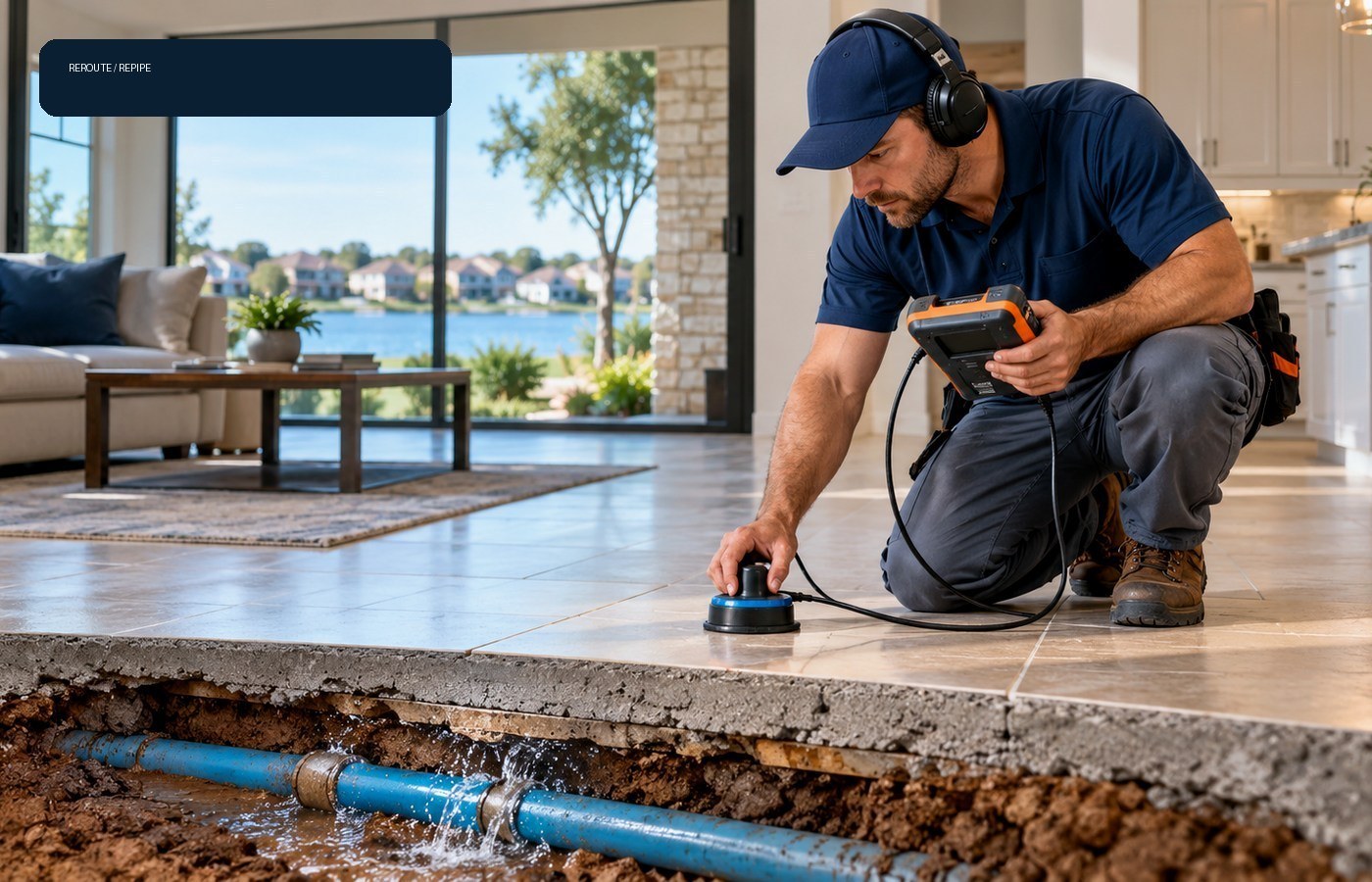
Under-slab repiping means installing new water lines to replace an existing under-slab system that keeps failing, instead of opening the slab for another single spot repair. It is the broadest answer to a slab leak problem: rather than fixing one break in a deteriorating line, the line itself is renewed. Homeowners usually arrive at this option after a pattern, not a single event, such as a second or third leak in the same system, rising repair bills, or a plumber reporting that the pipe material itself is breaking down. This page explains what repiping involves, when it is considered, how it differs from rerouting, and what the process looks like. For a direct comparison of the two broad approaches, see repair vs reroute.
What under-slab repiping is
Repiping is the replacement of water supply piping with new piping. In the under-slab context, it means the failing lines beneath the concrete are replaced by new lines, which may run under the slab along the old route or may be run through new paths above the slab, such as through walls, ceilings, or the attic, depending on the property and the plan. The key distinction is scope: a spot repair fixes one failure point, while a repipe renews the system or a defined portion of it.
Repipes can be partial or whole-house. A partial repipe replaces the lines serving one zone, such as the hot water loop or one bathroom wing, when the failures are concentrated there. A whole-house repipe replaces the main runs and branches throughout the home. The choice depends on the pipe condition, the failure pattern, and the layout of the home. A plumber assessing the system will look at the material, the age, the water chemistry effects, and where the failures have occurred to recommend a scope.
It helps to separate repiping from repair in your thinking. Repair answers the question of how to fix this leak. Repiping answers the question of how to stop the leaks from recurring. They are different strategies for different stages of a plumbing system's life, and choosing between them is one of the most consequential decisions a homeowner with repeat slab leaks will make.
When repiping is considered
The most common trigger is recurrence. One slab leak is an event; two or three are a pattern. Each spot repair opens the slab, disturbs finishes, and costs money, and when the underlying pipe is deteriorating, the next failure is a matter of time rather than chance. At some point the cumulative cost and disruption of repeated repairs approaches the cost of renewal, and repiping becomes the rational comparison.
Pipe condition is the second trigger. Some under-slab systems reach a state where the material itself is failing broadly: copper with widespread pitting from aggressive water chemistry, galvanized lines with internal corrosion narrowing the bore, or polybutylene and other materials with known systemic failure histories. When an inspection or a repair opening reveals that the pipe is compromised along its length, fixing one spot leaves a deteriorating remainder in the ground.
Age and material combinations also factor in. Older homes with original under-slab copper or galvanized systems, especially in areas with mineral-heavy or chemically aggressive water, tend to follow a predictable arc from first leak to repeated leaks. Water quality reports and the visible condition of exposed pipe at the water heater or manifold can give early warning. A homeowner planning to stay in the home long term may choose repiping proactively after the second failure rather than waiting for the third, a common pattern in established Little Elm neighborhoods.
Finally, repiping is considered when access for spot repairs is punishing. If the failing lines run under finished hardwood, custom tile, or a recently remodeled kitchen, each slab opening destroys expensive finishes. Renewing the lines through a new route can avoid repeated demolition of the same finished spaces.
Repiping vs rerouting: the difference
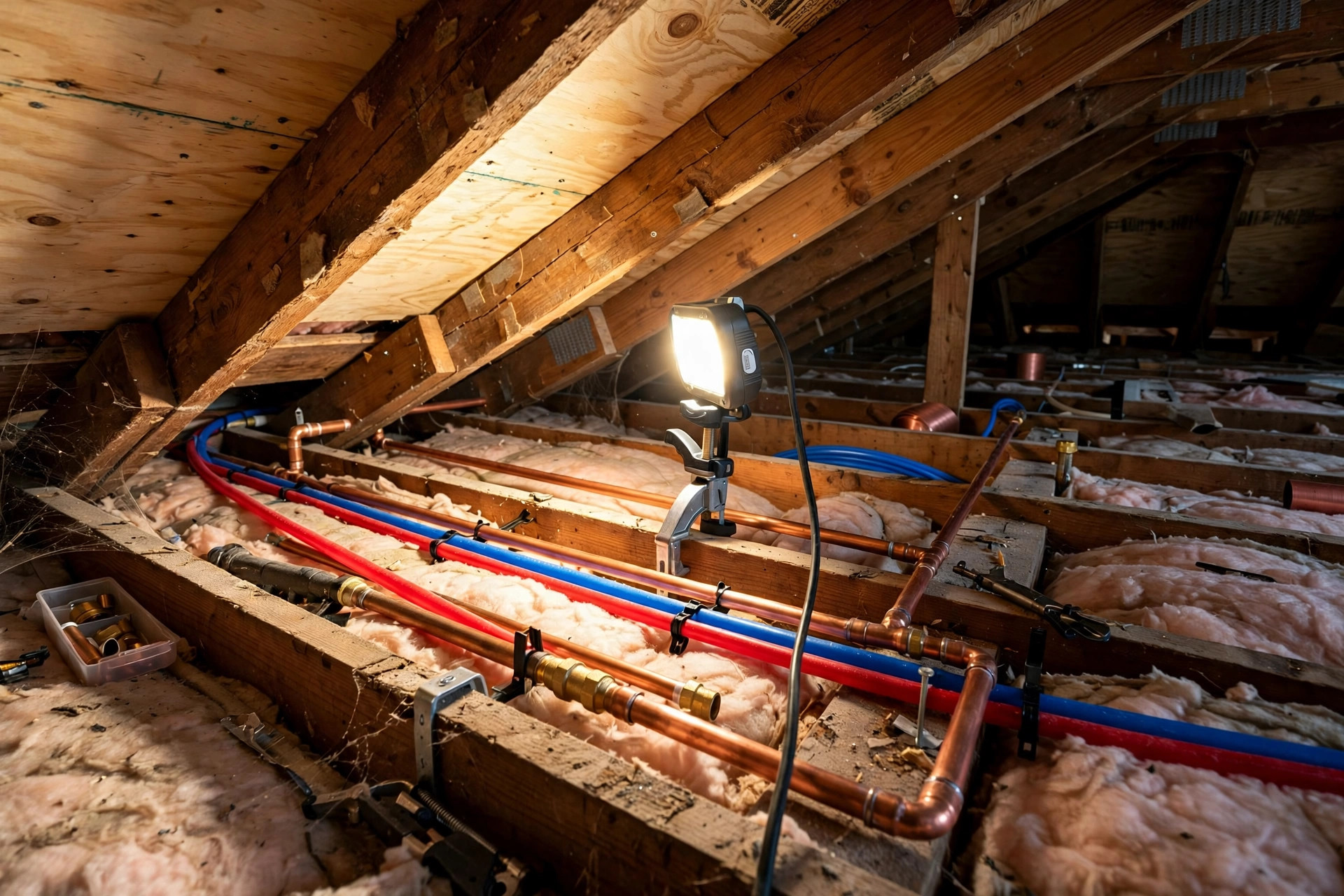
Repiping and rerouting are related but not identical, and the terms get mixed up often. Rerouting means abandoning the failing under-slab line and running a new line along a different path, typically overhead through the attic or along walls, to reach the same fixtures. The old pipe stays in the slab, dead and capped. Repiping is the broader term for replacing the piping system, and a repipe may itself use rerouted paths, or it may follow the original under-slab route with new pipe.
In practice, many under-slab repipes are accomplished by rerouting, because running new lines overhead avoids opening the slab at all. But a repipe can also mean new pipe in the same trench after the old line is exposed, and it can be partial, replacing only the failing zone. The useful distinction for a homeowner is this: rerouting describes the path the new pipe takes, while repiping describes the renewal of the system. When comparing proposals, ask what is being replaced, along what route, and what happens to the old lines.
Each approach has tradeoffs. Overhead reroutes avoid slab demolition but introduce long runs through unconditioned attic space, which raises questions about insulation, freeze protection, and pressure. Same-route replacement keeps runs short and protected but requires opening the slab. A good plan weighs these honestly against the home's layout rather than defaulting to one method.
How the process works
A repipe project moves through recognizable phases. It starts with assessment: mapping the existing system, identifying the failing material and the failure pattern, checking water pressure and fixture layout, and deciding the scope, whether partial or whole-house, and the route for the new lines. This is also when access, wall and ceiling openings, and restoration are scoped, because a repipe touches finishes and the plan should account for that from the start.
Next comes planning and permitting. The new layout is designed fixture by fixture: which walls the lines run through, where they rise and drop, how they are supported, and where shutoffs go. Local permit requirements apply to repipes as they do to other plumbing work, and inspections are typically part of the process. This phase also settles the material choice and the protection details, such as insulation on attic runs and nail plates where pipes pass through framing.
Installation follows. The water is shut off, often in stages so the home is not without water any longer than necessary, and the new lines are run, connected, and secured. Old under-slab lines that are being abandoned are disconnected and capped. Fixtures are reconnected to the new system, and each connection is checked as it is made.
Then comes testing. The new system is pressurized and held, and every joint and connection is inspected for weeping or drops before any wall or ceiling is closed. This pressure test is the quality gate of the whole project; closing finishes over an untested system is how callbacks happen. Only after the system holds does restoration begin: patching drywall, repainting, and repairing any slab openings if the route went under the slab.
The final step is documentation and cleanup. The homeowner should receive a record of what was replaced, the route the new lines take, the location of new shutoffs, and the test results. That record is valuable for future maintenance and for resale, since a documented repipe is a meaningful property record.
Materials in general terms
Repipe materials are usually discussed in general categories rather than brand names at the planning stage. Copper remains a common choice with a long track record, though it is subject to the same water chemistry concerns that caused pinhole failures in some older copper systems. Cross-linked polyethylene, commonly called PEX, is widely used for repipes because it is flexible, which reduces the number of fittings, and it resists scale and corrosion. CPVC is another option in some applications. Each material has different cost, longevity, and installation characteristics, and local code governs what is permitted.
The honest way to think about materials is that none is immune to failure; each fails differently and on different timelines. The right choice depends on the water chemistry in the home, the installation quality available, the budget, and how the lines will be routed and protected. A proposal that explains why a material was chosen for your specific situation is more trustworthy than one that presents a single option as universally best.
Limitations
Repiping is the most disruptive plumbing project a homeowner can undertake short of foundation work, and it should be entered with open eyes. Walls and ceilings will be opened, finishes will need repair and paint, and the home will be a work zone for the duration. For a whole-house repipe, that disruption is measured in days, not hours, and water service will be interrupted in stages.
It is also the highest-cost option among slab leak responses, which is why the comparison with repeated spot repairs should be done with real numbers rather than assumptions. If the system has failed once and the pipe otherwise looks sound, a spot repair is usually the proportionate response. Repiping earns its place when the failure pattern or the pipe condition justifies it.
Abandoned lines deserve a mention too. When a repipe uses new routes, the old under-slab lines remain in place, capped and dead. That is standard practice and generally harmless, but the homeowner should know they are there, and any future slab work should account for them. Finally, a repipe renews the supply piping; it does not address drain lines, which are a separate system with their own failure modes and tests.
Cost factors
Repipe pricing varies widely because the scope varies widely. The dominant factor is how much pipe is being replaced: a partial repipe of one zone costs less than a whole-house renewal. The route matters too, since long overhead runs with extensive attic work, insulation, and finish repair cost more than short same-trench replacements, and difficult access, such as multi-story chases or finished basements, adds labor.
Material choice affects the material portion of the cost, fixture count affects the connection count, and the extent of drywall, paint, and flooring restoration affects the finish portion. Permit and inspection fees apply, and any required upgrades discovered during the work, such as an aging main shutoff or a failing pressure regulator, can add to the total. Because the variables are so property-specific, meaningful pricing only comes from an on-site assessment, not from averages borrowed from other homes.
Frequently asked questions
How do I know I need a repipe instead of another spot repair?
The usual signals are recurrence, such as two or more leaks in the same system, visible deterioration of the pipe material at repair openings, and a pattern of failures moving along the same line. An assessment of the pipe condition, not just the latest leak, is what justifies the broader scope.
Will repiping require breaking up my slab?
Not necessarily. Many under-slab repipes are completed by rerouting new lines overhead through the attic or through walls, which avoids slab demolition entirely. Same-route replacement does require opening the slab. Any serious proposal should state which approach is planned and explain why it fits your home.
What happens to the old pipes under the slab?
Abandoned lines are typically disconnected, drained, and capped in place, which is standard industry practice. They remain in the slab as inert material while the new system operates independently of them. Note their location in your records so any future slab work can account for them.
How long does a repipe take?
A partial repipe may take a day or two, while a whole-house repipe typically takes several days depending on the home's size, the route complexity, and the extent of finish restoration. Water is usually restored in stages rather than all at once.
Does repiping fix drain line problems too?
No. Repiping renews the pressurized water supply lines only. Drain, waste, and vent piping is a separate system with its own materials, joints, and failure modes. If slow drains, backups, or odors suggest drain trouble, that system needs its own assessment, such as hydrostatic testing of the drain lines.
Which pipe material is best for a repipe?
There is no universally best material. Copper, PEX, and CPVC each have different strengths, lifespans, and installation requirements, and the right choice depends on your water chemistry, the planned routing, your budget, and local code. A trustworthy proposal explains the reasoning behind its recommendation for your specific home rather than pushing one option.